When it comes to sieving operations, one of the most critical factors that can significantly influence the sieving result is the shape of the sieve holes. As a professional sieves supplier, I've witnessed firsthand how different sieve hole shapes can bring about distinct outcomes in various industries. In this blog, I'll delve into the details of how the shape of sieve holes affects the sieving result, and provide some insights based on our experience in the market.
Common Sieve Hole Shapes and Their Characteristics
There are several common sieve hole shapes, each with its own unique properties. The most prevalent ones include round, square, and rectangular holes.
Round Holes
Round holes are perhaps the most widely used shape in sieving applications. Their symmetrical design offers a uniform flow path for particles passing through the sieve. This symmetry reduces the likelihood of particles getting stuck or bridging across the holes, which is especially beneficial when dealing with spherical or near - spherical particles. For example, in the pharmaceutical industry, when sieving pills or granules, round holes can ensure a smooth and efficient sieving process. The round shape also provides a consistent opening size, making it easier to control the particle size distribution of the sieved material.
Square Holes
Square holes offer a different set of advantages. They have a larger open area compared to round holes of the same nominal size. This means that more material can pass through the sieve in a given time, resulting in higher throughput. Square holes are often used in applications where a high - volume sieving is required, such as in the mining industry for sieving ores. However, square holes may be more prone to particle lodging, especially if the particles have irregular shapes. The corners of the square holes can act as traps for particles, which may reduce the sieving efficiency over time.
Rectangular Holes
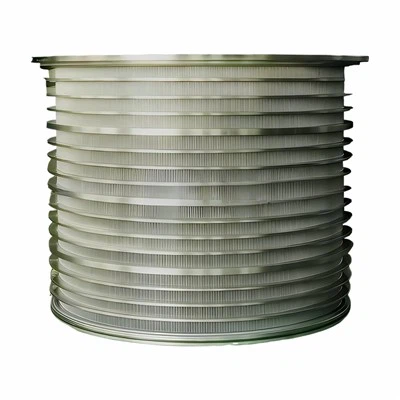
Rectangular holes are designed for specific applications where the orientation of the particles matters. They are particularly useful when sieving elongated or fibrous materials. For instance, in the paper industry, Paper Machine Vibrating Screen often uses rectangular holes to separate fibers based on their length. The long side of the rectangular hole allows the fibers to pass through more easily if they are aligned with the hole's orientation. This shape can also be adjusted to optimize the sieving process for different fiber lengths, providing a high degree of control over the final product quality.
Impact on Particle Separation Efficiency
The shape of the sieve holes directly affects the particle separation efficiency. Different hole shapes interact with particles in various ways, which can either enhance or impede the separation process.
Selectivity
Selectivity refers to the ability of a sieve to separate particles based on their size. Round holes are known for their high selectivity. Since they have a well - defined opening size, they can accurately separate particles within a narrow size range. This is crucial in industries where precise particle size control is required, such as in the food industry for sieving flour or in the chemical industry for separating fine powders.
Square and rectangular holes, on the other hand, may have lower selectivity due to their larger open areas and irregular geometries. However, in some cases, this can be an advantage. For example, in the recycling industry, where a broader range of particle sizes needs to be separated, square or rectangular holes can be more effective in quickly sorting out different materials.
Throughput
As mentioned earlier, the shape of the sieve holes can have a significant impact on the throughput. Sieve holes with a larger open area, such as square and rectangular holes, generally allow for higher throughput. This is because more particles can pass through the sieve simultaneously. In high - volume production environments, such as in the cement industry, maximizing throughput is essential to meet production targets. Therefore, square or rectangular hole sieves are often preferred in these applications.
However, it's important to note that increasing the throughput may come at the cost of selectivity. A sieve with a high throughput may not be as effective in separating particles of very similar sizes.
Influence on Sieve Wear and Maintenance
The shape of the sieve holes also affects the wear and maintenance requirements of the sieve. Different hole shapes experience different levels of abrasion and particle impact, which can lead to varying degrees of wear.
Abrasion
Round holes tend to experience more uniform abrasion compared to square and rectangular holes. The smooth, circular shape distributes the particle impact evenly around the hole perimeter. This results in a more consistent wear pattern, which can extend the lifespan of the sieve. In contrast, square and rectangular holes have corners and edges that are more susceptible to abrasion. The particles hitting these sharp corners can cause faster wear, which may require more frequent sieve replacements.
Particle Lodging and Clogging
Particle lodging and clogging are common problems in sieving operations. The shape of the sieve holes plays a crucial role in determining the likelihood of these issues. Round holes are less likely to experience particle lodging due to their symmetrical shape. Particles are more likely to roll through the holes rather than getting stuck. Square holes, with their corners, are more prone to particle lodging, especially if the particles have irregular shapes. Rectangular holes can also be susceptible to clogging, particularly if the fibers or elongated particles become entangled in the holes.
Regular maintenance, such as cleaning and inspection, is essential to prevent particle lodging and clogging. For sieves with square or rectangular holes, more frequent cleaning may be required to ensure optimal performance.
Application - Specific Considerations
Different industries have specific requirements when it comes to sieving, and the choice of sieve hole shape should be tailored to these needs.


Food Industry
In the food industry, hygiene and precise particle size control are of utmost importance. Round hole sieves are often preferred for sieving ingredients such as flour, sugar, and spices. Their smooth surface and high selectivity ensure that the final product meets the strict quality standards. Additionally, round hole sieves are easier to clean, which is crucial for maintaining food safety.
Mining Industry
The mining industry requires high - throughput sieving to process large volumes of ore. Square or rectangular hole sieves are commonly used in this industry to maximize the amount of material that can be processed in a given time. These sieves are designed to withstand the harsh conditions of mining operations, including high - impact particle flow and abrasive materials.
Paper Industry
As mentioned earlier, the paper industry relies on Fibernet Screen with rectangular holes to separate fibers based on their length. This allows for the production of paper with consistent quality and properties. The ability to control the fiber length distribution is essential for achieving the desired paper strength, smoothness, and other characteristics.
Conclusion
In conclusion, the shape of the sieve holes has a profound impact on the sieving result. It affects particle separation efficiency, throughput, sieve wear, and maintenance requirements. As a sieves supplier, we understand the importance of choosing the right sieve hole shape for each application. By considering the specific needs of different industries, we can provide our customers with sieves that offer optimal performance and reliability.
If you're in need of high - quality sieves for your specific application, we're here to help. Our team of experts can assist you in selecting the most suitable sieve hole shape and design to meet your requirements. Contact us today to start a discussion about your sieving needs and explore how our products can enhance your operations.
References
- Rumpf, H. (1975). Mechanical Separation Processes. Springer - Verlag.
- Svarovsky, L. (1990). Solid - Liquid Separation. Butterworth - Heinemann.
- Perry, R. H., & Green, D. W. (1997). Perry's Chemical Engineers' Handbook. McGraw - Hill.