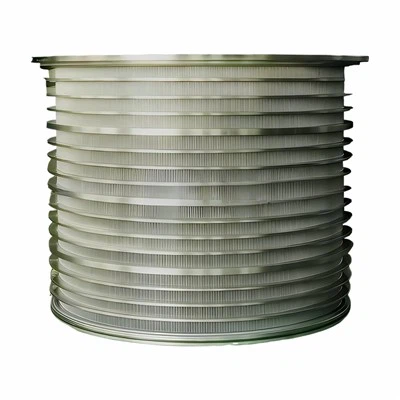
As a supplier of Toothed Deflakers, I'm excited to share with you the working principle of this remarkable piece of equipment. Toothed Deflakers play a crucial role in the pulp and paper industry, and understanding how they work can help you make informed decisions when it comes to your refining processes.
The Basics of a Toothed Deflaker
A Toothed Deflaker, like the one you can learn more about Toothed Deflaker, is designed to break up pulp bundles and agglomerates. In the pulp production process, pulp fibers often form clumps during various stages such as storage, transportation, or initial processing. These clumps can have a negative impact on the quality of the final paper product, causing unevenness, weak spots, and other defects.
The main components of a Toothed Deflaker typically include a rotor and a stator. The rotor is the rotating part of the machine, while the stator remains stationary. Both the rotor and the stator are equipped with teeth or blades that are specifically designed to interact with the pulp fibers.


Working Principle in Detail
1. Feed of Pulp
The process begins with the feed of pulp into the Toothed Deflaker. The pulp, usually in a liquid suspension, enters the machine through an inlet. The consistency of the pulp can vary depending on the specific requirements of the process, but it is typically in the range of 2 - 5%. The pulp is then directed towards the gap between the rotor and the stator.
2. Rotor - Stator Interaction
Once the pulp is in the gap between the rotor and the stator, the high - speed rotation of the rotor creates a powerful shearing force. The teeth on the rotor and the stator are arranged in a way that they pass by each other at high speed. As the pulp fibers pass through this narrow gap, the shearing action between the teeth breaks up the pulp bundles and agglomerates.
The design of the teeth is crucial for the effectiveness of the deflaking process. Different tooth geometries can be used depending on the type of pulp being processed and the desired level of deflaking. For example, some teeth may be sharp and pointed to provide a more aggressive cutting action, while others may be more rounded to provide a gentler shearing effect.
3. Fiber Liberation
As the pulp bundles are broken up, individual fibers are liberated. This is an important step because it allows the fibers to be more evenly dispersed in the pulp suspension. Liberated fibers can then be better aligned during the papermaking process, resulting in a more uniform and stronger paper product.
4. Energy Consumption
The Toothed Deflaker consumes energy to drive the rotation of the rotor. The amount of energy required depends on several factors, including the size of the machine, the speed of the rotor, the consistency of the pulp, and the degree of deflaking required. However, compared to some other refining equipment, Toothed Deflakers are generally more energy - efficient when it comes to breaking up pulp bundles.
Comparison with Other Refining Equipment
Toothed Deflaker vs. DD Series Double Disc Refiner
The DD Series Double Disc Refiner is another important piece of equipment in the pulp and paper industry. While both the Toothed Deflaker and the DD Series Double Disc Refiner are used for pulp refining, they have different functions.
The DD Series Double Disc Refiner is mainly used for fibrillation of pulp fibers. Fibrillation is the process of creating fine fibrils on the surface of the pulp fibers, which improves the bonding ability of the fibers and enhances the strength of the paper. In contrast, the Toothed Deflaker focuses on breaking up pulp bundles and agglomerates without significant fibrillation.
Toothed Deflaker vs. KTF Refiner
The KTF Refiner is also designed for pulp refining. It has a different structure and working principle compared to the Toothed Deflaker. The KTF Refiner uses a different type of refining element and is often used for more specific refining tasks, such as refining high - consistency pulp. The Toothed Deflaker, on the other hand, is more suitable for deflaking pulp at lower consistencies.
Applications of Toothed Deflakers
Toothed Deflakers are widely used in various sectors of the pulp and paper industry. They are used in the production of different types of paper, including newsprint, printing and writing paper, packaging paper, and tissue paper.
In the production of newsprint, for example, Toothed Deflakers help to ensure that the pulp fibers are well - dispersed, which is essential for producing a smooth and uniform paper surface. In the packaging paper industry, deflaking the pulp can improve the strength and durability of the final product.
Advantages of Our Toothed Deflakers
As a supplier of Toothed Deflakers, we offer several advantages. Our Toothed Deflakers are designed with high - quality materials and advanced manufacturing techniques. This ensures long - term reliability and low maintenance requirements.
We also provide customized solutions based on your specific needs. Whether you have a small - scale paper mill or a large - scale industrial operation, we can design and manufacture a Toothed Deflaker that meets your production requirements.
In addition, our technical support team is always ready to assist you. We can provide training on the operation and maintenance of the Toothed Deflaker, as well as troubleshooting services in case of any issues.
Contact Us for Purchase and Negotiation
If you are interested in learning more about our Toothed Deflakers or if you are considering purchasing one for your pulp and paper production, we encourage you to contact us. Our sales team is eager to discuss your specific requirements and provide you with a detailed quotation. We believe that our Toothed Deflakers can bring significant improvements to your refining processes and ultimately enhance the quality of your paper products.
References
- Smook, G. A. (2016). Handbook for Pulp & Paper Technologists. Angus Wilde Publications.
- Gullichsen, J., & Fogelholm, C. - J. (Eds.). (2000). Paper Machine Clothing. Fapet Oy.