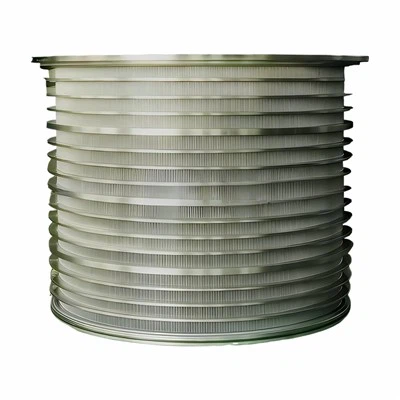
Hey there! As a supplier of Toothed Deflakers, I'm super stoked to share with you how these nifty machines work with a pulp refining system. So, let's dive right in!


First off, let's talk a bit about what a Toothed Deflaker is. You can check out more details about it Toothed Deflaker. A Toothed Deflaker is a key piece of equipment in the pulp and paper industry. Its main job is to break up and separate the pulp fibers that have clumped together, or "flaked," during the pulping process. These flakes can cause all sorts of problems in the subsequent steps of paper production, like uneven paper formation and reduced paper strength.
Now, let's get into how it fits into a pulp refining system. A pulp refining system is designed to improve the quality of the pulp by refining and shaping the fibers. This process generally involves mechanical treatment to increase the flexibility, bonding ability, and other physical properties of the pulp.
When the pulp first comes out of the pulping process, it often contains these large flakes of fiber bundles. That's where the Toothed Deflaker steps in. The pulp is fed into the deflaker, and inside, there are rotating and stationary discs with teeth. As the discs rotate, the teeth on them work to shear and break apart the fiber flakes. It's like a high - tech fiber "disassembler."
The mechanical action of the Toothed Deflaker is pretty awesome. The teeth on the discs create a high - shear force as they pass by each other. This force is what breaks the hydrogen bonds between the fibers in the flakes. Once these bonds are broken, the individual fibers are released and can be more evenly distributed throughout the pulp suspension.
But how does this tie in with the overall pulp refining system? Well, after the deflaking process, the pulp is in a much better state for further refining. By separating the fibers at this early stage, the subsequent refining equipment can work more efficiently. For example, if we were to use a DD Series Double Disc REfiner after the Toothed Deflaker, it would be able to focus more on refining the individual fibers rather than having to break up the large flakes first.
The DD Series Double Disc Refiner works by passing the pulp between two rotating discs. The discs have a specific pattern of bars and grooves that further refine the fibers. When the pulp has already been deflaked, the refiner can achieve a more uniform and consistent refining effect. This leads to better - quality paper with improved strength and smoothness.
Another type of refiner that can work well in conjunction with the Toothed Deflaker is the KZM Series Conical Refiner. This refiner has a conical shape, and the pulp is forced through the narrowing gap between the conical surfaces. The deflaked pulp can flow more easily through this gap, allowing the conical refiner to do its job of further refining and fibrillating the fibers more effectively.
One of the great things about the Toothed Deflaker is its adjustability. You can control the gap between the rotating and stationary discs, which in turn affects the intensity of the deflaking process. If you have a pulp with very large and tough flakes, you can set a smaller gap to increase the shear force. On the other hand, if the flakes are relatively small and easy to break, a wider gap can be used to save energy.
The Toothed Deflaker also has a high throughput. It can handle a large volume of pulp in a short period of time, which is crucial in a high - volume pulp and paper production environment. This high throughput ensures that the overall pulp refining system can keep up with the production demands.
In terms of maintenance, the Toothed Deflaker is relatively easy to take care of. The discs can be replaced when they wear out, and regular cleaning and lubrication of the moving parts can keep the machine running smoothly for a long time.
Now, let's talk about the benefits of using a Toothed Deflaker in your pulp refining system. Firstly, it improves the quality of the final paper product. By breaking up the flakes and ensuring a more uniform fiber distribution, the paper has better strength, smoothness, and printability. Secondly, it increases the efficiency of the subsequent refining equipment. As we mentioned earlier, the refiner can work more effectively on individual fibers, which means less energy is wasted on trying to break up the large flakes. Thirdly, it can save on production costs. With better - quality pulp and more efficient refining, you may need less raw materials and energy to produce the same amount of paper.
If you're in the pulp and paper industry and looking to improve your pulp refining system, a Toothed Deflaker is definitely worth considering. It's a reliable and effective piece of equipment that can make a big difference in your production process.
If you're interested in purchasing a Toothed Deflaker or learning more about how it can fit into your specific pulp refining system, don't hesitate to reach out. I'd be more than happy to discuss your needs and provide you with all the information you need.
References
- Pulp and Paper Handbook: This handbook provides in - depth knowledge about the pulp and paper production process, including the role of deflakers and refiners.
- Industry research papers on pulp refining technology: These papers offer the latest research findings and technological advancements in the field of pulp refining.