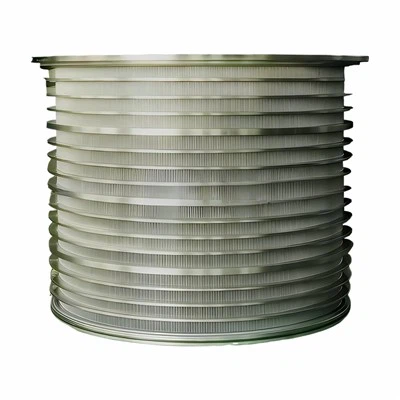
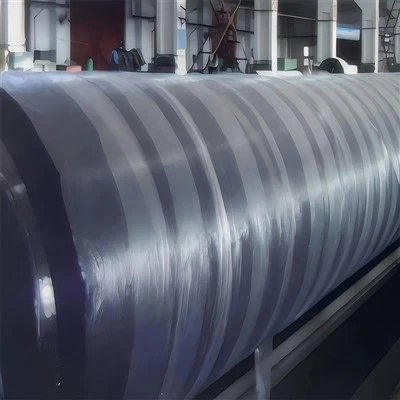
Hey there! I'm a supplier of Disc Thickeners, and today I wanna chat about something super important in the world of fine particle separation: the effect of disc speed.
Let's start by understanding what fine particle separation is all about. Fine particles are those tiny little bits that can be a real pain to separate from a liquid or other substances. Think about paper manufacturing, where you've got all these small fibers and debris that need to be sorted out. That's where thickeners like our Disc Thickener come in handy.
So, what exactly is a Disc Thickener? Well, it's a piece of equipment designed to increase the consistency of a pulp or slurry by removing water. It consists of a series of discs that rotate in a tank filled with the material to be thickened. As the discs turn, they capture the solid particles and allow the water to drain away. You can learn more about it here.
Now, let's dive into the main topic: the effect of disc speed on the separation of fine particles. The disc speed plays a crucial role in how well the thickener works. When the discs rotate at a higher speed, several things happen.
First off, a higher disc speed increases the shear force in the thickener. Shear force is like a kind of "pulling" or "tearing" force that acts on the particles in the slurry. With more shear force, the fine particles are more likely to break away from each other and from the liquid. This can be a good thing because it allows for better separation. For example, in a paper mill, the fibers can be more easily separated from the water and other contaminants when there's enough shear force.
However, there's a catch. If the disc speed is too high, it can also cause some problems. One of the main issues is that it can lead to re - dispersion of the particles. Re - dispersion means that the particles that were supposed to be separated and settled down get mixed back into the liquid. This defeats the purpose of thickening and can result in a lower - quality end product.
On the other hand, when the disc speed is too low, the shear force is insufficient. The fine particles may not be properly detached from the liquid, and they might not move towards the discs effectively. This can lead to poor separation efficiency, and the thickener may not be able to achieve the desired consistency of the pulp or slurry.


To find the optimal disc speed, you need to consider a few factors. The type of fine particles is a big one. Different materials have different properties, such as size, shape, and density. For instance, if you're dealing with very small and light particles, they may require a different disc speed compared to larger and heavier ones.
The concentration of the slurry also matters. A more concentrated slurry may need a different disc speed than a less concentrated one. If the slurry is too thick, a higher disc speed might be needed to ensure proper mixing and separation. But if it's too thin, a lower speed could be sufficient.
Another factor is the viscosity of the liquid. Viscosity refers to how thick or "sticky" the liquid is. A more viscous liquid will require more force to move the particles through it. So, in a highly viscous slurry, a higher disc speed may be necessary to overcome the resistance and achieve good separation.
Let's compare our Disc Thickener with some other thickening equipment in terms of disc speed and particle separation. Take the Inclined Screw Thickenner for example. It works in a different way compared to the Disc Thickener. Instead of rotating discs, it uses a screw to move the material and separate the particles. The speed of the screw in an Inclined Screw Thickenner also affects the separation process, but the principles are a bit different.
The Gravity Cylinder Thickener Ⅰ relies mainly on gravity to separate the particles. The disc speed concept doesn't really apply here in the same way as in a Disc Thickener. It's more about the settling time and the design of the cylinder to allow the particles to settle at the bottom.
In practical applications, finding the right disc speed often involves some trial and error. You start with an estimated speed based on the characteristics of the material and the thickener. Then, you monitor the performance of the thickener. You can look at things like the consistency of the output, the clarity of the separated water, and the amount of solids in the final product.
If the output consistency is too low, it might mean the disc speed is too low, and you need to increase it. If the water isn't clear enough or there are too many solids in the water, it could be a sign that the disc speed is too high and causing re - dispersion.
As a Disc Thickener supplier, I've seen many customers struggle with finding the optimal disc speed. That's why we offer technical support to help them. We can analyze the specific requirements of their application, such as the type of fine particles, the slurry concentration, and the desired end - product quality. Based on this analysis, we can recommend the best disc speed and provide guidance on how to adjust it over time.
If you're in the market for a thickening solution and are considering a Disc Thickener, I encourage you to reach out. We've got a wide range of Disc Thickeners that can be customized to meet your specific needs. Whether you're in the paper industry, mining, or any other field that requires fine particle separation, our equipment can make a big difference.
Contact us to start a discussion about your project. We'll be happy to share our expertise and help you find the best disc speed for your application. Together, we can ensure that you get the most efficient and effective fine particle separation possible.
References
- Smith, J. (2020). Principles of Particle Separation in Industrial Processes. New York: Industrial Press.
- Brown, A. (2019). Thickening Equipment and Their Applications. London: Chemical Engineering Journal.