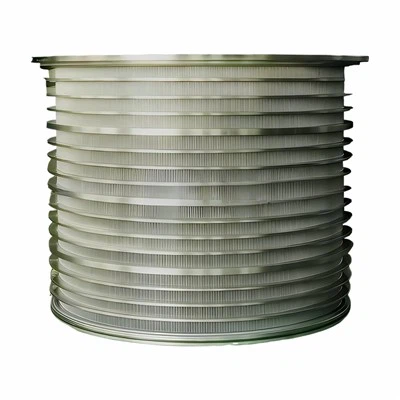
In the realm of pulp and paper processing, the disc heat-disperser stands as a pivotal piece of equipment, playing a crucial role in refining and treating pulp fibers. As a leading supplier of Disc Heat-Disperser, I've witnessed firsthand the intricate relationship between various operational parameters and the performance of these machines. One such parameter that significantly influences the efficiency and effectiveness of a disc heat-disperser is the disc spacing. In this blog post, I'll delve into the impact of disc spacing on the pressure drop in a disc heat-disperser, exploring the underlying mechanisms, practical implications, and considerations for optimal operation.
Understanding the Disc Heat-Disperser
Before we dive into the specifics of disc spacing and pressure drop, let's briefly review the basic principles of a disc heat-disperser. This machine consists of a set of rotating and stationary discs, which are closely spaced and arranged in a stack. As the pulp slurry passes through the narrow gaps between the discs, it undergoes intense mechanical shearing and mixing, breaking down agglomerates, dispersing contaminants, and improving the overall quality of the pulp.
The heat generated during this process helps to soften the fibers, making them more pliable and easier to refine. Additionally, the high shear forces applied to the pulp can enhance the fibrillation of the fibers, increasing their surface area and improving their bonding properties. These combined effects result in a higher-quality pulp with improved strength, brightness, and uniformity.
The Role of Disc Spacing
Disc spacing refers to the distance between the rotating and stationary discs in a disc heat-disperser. This parameter plays a critical role in determining the intensity of the mechanical forces applied to the pulp, as well as the flow characteristics of the slurry through the machine. A smaller disc spacing results in a narrower gap between the discs, which increases the shear forces acting on the pulp and enhances the dispersion and refining effects. However, it also increases the resistance to flow, leading to a higher pressure drop across the machine.


Conversely, a larger disc spacing reduces the shear forces and the pressure drop, but it may also result in less effective dispersion and refining of the pulp. Therefore, finding the optimal disc spacing is essential for achieving the desired balance between pulp quality and energy efficiency.
Impact on Pressure Drop
The pressure drop across a disc heat-disperser is a measure of the resistance to flow encountered by the pulp slurry as it passes through the machine. It is influenced by several factors, including the disc spacing, the flow rate of the slurry, the viscosity of the pulp, and the design of the discs.
As the disc spacing decreases, the gap between the discs becomes narrower, and the pulp slurry is forced to flow through a more restricted passage. This increases the velocity of the slurry and the shear forces acting on it, resulting in a higher pressure drop. The relationship between disc spacing and pressure drop is typically nonlinear, with the pressure drop increasing exponentially as the disc spacing decreases.
In addition to the mechanical resistance to flow, the pressure drop can also be affected by the formation of a boundary layer of pulp fibers on the surface of the discs. This boundary layer can act as a barrier to flow, increasing the resistance and further contributing to the pressure drop. The thickness of the boundary layer is influenced by the disc spacing, with a smaller disc spacing resulting in a thinner boundary layer and a lower pressure drop.
Practical Implications
The impact of disc spacing on pressure drop has several practical implications for the operation of a disc heat-disperser. Firstly, a higher pressure drop requires more energy to pump the pulp slurry through the machine, increasing the operating costs. Therefore, it is important to optimize the disc spacing to minimize the pressure drop while still achieving the desired level of pulp quality.
Secondly, a high pressure drop can also lead to mechanical stress on the discs and other components of the machine, increasing the risk of wear and tear and reducing the lifespan of the equipment. Regular maintenance and monitoring of the pressure drop can help to identify any issues early on and prevent costly breakdowns.
Finally, the pressure drop can also affect the flow distribution of the pulp slurry within the machine. A non-uniform pressure drop can result in uneven flow through the discs, leading to inconsistent refining and dispersion of the pulp. This can have a negative impact on the quality of the final product and may require additional processing steps to correct.
Considerations for Optimal Operation
To achieve optimal operation of a disc heat-disperser, it is important to consider several factors when selecting the disc spacing. These include the type and quality of the pulp, the desired level of refining and dispersion, the flow rate of the slurry, and the energy efficiency requirements of the process.
In general, a smaller disc spacing is recommended for applications where a high level of refining and dispersion is required, such as in the production of high-quality paper grades. However, this should be balanced against the increased energy consumption and the potential for mechanical stress on the machine.
For applications where a lower level of refining is acceptable, a larger disc spacing can be used to reduce the pressure drop and improve the energy efficiency of the process. This may be suitable for the production of lower-quality paper grades or for applications where the pulp is already relatively well-refined.
It is also important to note that the optimal disc spacing may vary depending on the specific design and operating conditions of the disc heat-disperser. Therefore, it is recommended to consult with the equipment manufacturer or a qualified engineer to determine the most appropriate disc spacing for your specific application.
Conclusion
In conclusion, the disc spacing has a significant impact on the pressure drop in a disc heat-disperser, which in turn affects the energy consumption, mechanical stress, and flow distribution of the machine. Finding the optimal disc spacing is essential for achieving the desired balance between pulp quality and energy efficiency, and it requires careful consideration of several factors, including the type and quality of the pulp, the desired level of refining and dispersion, and the operating conditions of the process.
As a supplier of Disc Heat-Disperser, we are committed to providing our customers with the highest-quality equipment and technical support to help them optimize the performance of their disc heat-dispersers. If you have any questions or would like to learn more about our products and services, please don't hesitate to contact us. We look forward to working with you to achieve your pulp and paper processing goals.
References
- Smith, J. D., & Johnson, R. K. (2015). Pulp and Paper Manufacturing: Principles and Practice. CRC Press.
- Gullichsen, J., & Paulapuro, H. (Eds.). (2000). Handbook of Pulp. John Wiley & Sons.
- Paper Machine Kneader - A related product that can be used in conjunction with a disc heat-disperser for further pulp processing.