


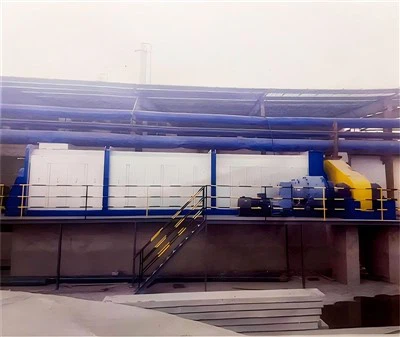
Pulp Residue Sarew Press
Application
Used to handle paper pulping system low enriched slag and fine screen end discharge of tailings.
Features
Does helical blade whole add special wear-resisting layer, increase its service life.
When slag treatment effect is good, is an ideal equipment to solid form impurity concentration.
Structural Components
1.Screw Shaft
Usually meticulously fabricated from high-strength alloy steel that undergoes special heat treatment and tempering processes, possessing outstanding mechanical properties. It has high hardness and strong wear resistance, capable of resisting the wear and erosion of pulp residues during long-term operation.
The pitch and diameter of the screw shaft are precisely designed to meet the requirements of different processing capacities and pulp residue characteristics. The variation of the pitch can control the advancement speed and extrusion degree of the pulp residues within the machine, thereby achieving the best thickening effect.
The surface of the screw shaft may undergo special coating treatments, such as hard chrome plating or ceramic coating, further enhancing its wear resistance and corrosion resistance and prolonging its service life.
2.Filter Screen
Utilizes high-precision stainless steel filter screens, typically made of 304 or 316 stainless steel, which have excellent corrosion resistance and high-temperature resistance.
The pore size of the filter screen is extremely fine and uniform, capable of effectively intercepting fine fibers and impurities in the pulp residues while allowing water to pass through smoothly.
The structure of the filter screen is sturdy. Through a special weaving method and support frame, it can withstand the huge pressure generated when the screw shaft extrudes the pulp residues without deformation or damage.
To facilitate replacement and maintenance, the filter screen is usually designed as a detachable modular structure.
3.Housing
Generally manufactured from thick metal materials, such as cast iron or carbon steel. The thickness and strength of the housing are sufficient to withstand the high pressure and vibration generated during internal operation.
The shape and size of the housing are optimized, and the internal space is reasonable to ensure the smooth flow and extrusion of the pulp residues.
The surface of the housing undergoes anti-rust and anti-corrosion treatments to adapt to the humid and chemically rich environment of the papermaking workshop.
On the housing, there are also observation windows and access doors to facilitate the operator to observe the internal working conditions and conduct daily maintenance.
4.Drive Device
Comprises components such as the motor, reducer, and coupling. The motor is typically a high-power three-phase asynchronous motor that can provide sufficient torque and power.
The reducer is used to reduce the high speed of the motor to the appropriate speed required by the screw shaft and increase the torque output.
The coupling connects the motor and the reducer to ensure stable and reliable power transmission.
5.Feed Inlet and Discharge Outlet
The feed inlet is designed to be spacious, usually in the shape of a funnel, to facilitate the rapid and uniform entry of pulp residues into the thickener.
The discharge outlet is divided into a solid phase outlet and a liquid phase outlet. The solid phase outlet is used to discharge the thickened pulp residues, and the liquid phase outlet is used to discharge the separated water.
6.Support and Installation Components
Include the base, brackets, and anchor bolts, etc., used to stably support the entire thickener and ensure that it does not shift or shake during operation.
Working Principle
1.Feeding
The tailings discharged from the low-concentration slag removers and the final stage of fine screens in the papermaking pulping system are conveyed to the feed inlet of the pulp residue thickener through conveying equipment, such as pipelines or screw conveyors.
2.Extrusion and Thickening
After the pulp residues enter the thickener, they move forward under the push of the screw shaft. The rotation of the screw shaft and the variation of the pitch exert an extrusion effect on the pulp residues, causing the water in the pulp residues to be squeezed out through the filter screen.
As the pulp residues advance within the machine, the pressure gradually increases, the water is continuously separated, and the concentration of the pulp residues gradually increases.
3.Discharge
The thickened pulp residues are discharged from the solid phase outlet and can be collected for subsequent processing or reuse. The separated water is discharged from the liquid phase outlet and can usually be recycled or further processed.
Performance Characteristics
|
Type |
ZNJ26 |
|
Consistency of inflow pulp |
1.5-3.5% |
|
Consistency of outflow pulp |
35-48% |
|
Treating capacity |
50~80m³/h |
|
Power of motor |
7.5kw |
|
Boundry |
3050×650×960 |
Hot Tags: pulp residue sarew press, China pulp residue sarew press suppliers, factory, 2640 350 Pope Reel, Sediment Washer, 5600 550 Sizing Machine, Pulp Residue Sarew Press, 3660X3350 Yankee Dryer, UV Pressure Screen
Previous
No InformationYou Might Also Like




Send Inquiry